Education institutes
Admissions, fees, batches, attendance and corporate coordination in one system. The Indo-German Training Centre saves staff 20% of their week.

What We Do
Design, develop and automate with the same people, then keep it running and get it found.
View All Services Design (UI/UX) Websites and apps people find easy to use and act on. Website & App Development Websites, apps and software, developed clean and integrated with your tools.
 AI & Automation Cut manual work and get the time back for what matters.
 Support & MaintenanceOne partner all year, under an AMC.
 Increase VisibilitySEO, Google Ads, content and social.
Not sure where to start? Get a tech audit and a plan
Projects that moved the numbers
The project success is measured by what changed for the client: more sales, more enquiries, hours saved.
View All ProjectsIndustries We Serve
Five industries with named clients and published results. Each page starts with what usually breaks in that business.
View All Industries EducationAdmissions, fees, student records and learning systems.
 Events & HospitalityTicketing, QR entry, venue booking and guest messaging.
 ManufacturingDealer portals, quotations, sales tracking and configurators.
 E-commerceStores, stock, orders and invoices in one flow.
 Family BusinessesOne process at a time, old and new side by side.
Eleven years of shipping software has taught us that speed and quality are not a trade-off.
Know More About Us
“They are super organized and professional.”

We’re always looking for designers, engineers and problem-solvers who care about outcomes.
See Open RolesTell us where your business stands today, the challenges you’re facing, and where you want to go next.
Portals, ticketing systems, integrations and apps built around how your business works, by a Pune team you can meet. You own the code.


Autuskey is a custom software development company in Kharadi, Pune. We build web portals, ticketing and booking systems, CRM and ERP integrations, mobile apps and the tools that replace spreadsheets, for businesses in India, the UAE, Europe, the US and Australia. Every project starts with a written scope and a fixed price against it, runs on a staging site with weekly demos, and ends with code, data and accounts in your name. The Indo-German Training Centre's system saves staff 20% of their week; Elixir Soltek's sales platform made management decisions 45% faster.
Custom software development is building an application around how one business works, rather than bending the business around a product built for thousands. It is the right choice when the process is yours, when many kinds of user need different views of the same data, or when live data from other systems and heavy calculation are the heart of the job. When off-the-shelf software or WordPress would do the job for less, we say so and build that instead.
Our custom web application development company in Pune has built this way since 2015: an education management system for the Indo-German Training Centre, a sales automation platform for Elixir Soltek Magsol, a sports facility booking SaaS for GW Sports, and ticketing platforms for nightlife groups in Goa and Dubai. One in-house team does the design, the build and the care, and nothing is subcontracted.
Projects delivered
Client rating
Businesses we work with
Founded in Pune
Each service is delivered by the same team, from the first call through to launch and the years after.
 01
Customer, dealer, member and student portals with role-based views. PULA Pune Ladies cut process time by 60%.
 02
QR entry, resellers, venues and reports. A Dubai multi-club platform raised ticket sales by 30%.
 03
Systems that share data by API instead of by retyping. Elixir Soltek's decisions are 45% faster.
 04
Spreadsheets, registers and ageing apps replaced by one connected system, in stages.
 05
Flutter and React Native apps with their own backends. The Pune Eat Outs app grew membership by 200%.
 06
Clickable prototypes before code, so the decision is made on something everyone can see.
07 A written review of code, security, hosting and workflows, with a ranked plan.
A business needs custom software when the process it runs on is its own: when the spreadsheet beside the tool has become the real system, when one person is the only one who understands how the data fits together, or when customers, dealers or students email for things a login should give them. Custom business application development is how a small business in India with 30 to 200 crore in revenue, or an overseas company with a specific product, gets a system that fits. These six kinds of business bring us most of the work.
Admissions, fees, batches, attendance and corporate coordination in one system. The Indo-German Training Centre saves staff 20% of their week.
Sales tracking, dealer orders and reporting without spreadsheets. Elixir Soltek Magsol makes management decisions 45% faster.

Ticketing with QR entry, resellers and multi-venue reports. Tito's Hospitality accepts 0% duplicate tickets at the door.

Facility booking SaaS with slots, payments and admin. GW Sports improved booking efficiency by 50%.
Platforms and integrations that keep access in step with payment. NexGen grew subscriptions by 42%.
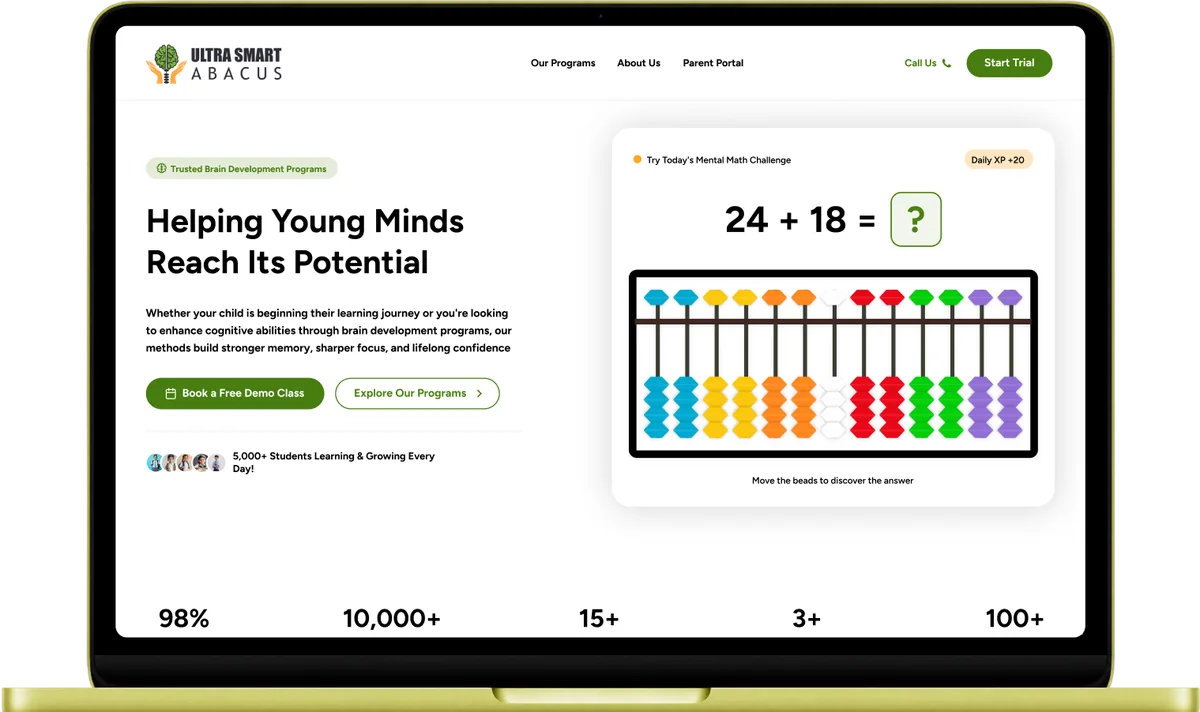
One process at a time, old and new side by side. An abacus coaching centre moved 90% of its records into one system.
Build custom software when the process is yours and the tool would have to be bent to fit; buy off-the-shelf software when your process is standard and a maintained product covers it. When to build custom software for your business is usually clear from three questions: does one person hold the process in their head, do several kinds of user need different views of the same data, and does the tool you use make you re-key data into something else? Two or three yeses mean build.
| Off-the-shelf software | WordPress with plugins | Custom software | |
|---|---|---|---|
| Best for | A standard process a maintained product covers | Content, members, bookings and courses with moderate logic | A process that is yours, many user types, live data, heavy calculation |
| Fit | Its way of working | Mostly yours, with plugins | Exactly yours |
| Cost to start | A subscription per user | From ₹50,000 | From ₹50,000; quoted against scope |
| Cost over time | Grows with users and modules | Low; an AMC | Low after launch; an AMC |
| Ownership | A licence | The site and data, yours | Everything, yours |
| Our honest advice | Try it first if your process is standard | When the content side matters | When the software is how you work |
Software gets used when it is built around the current workflow and shown to the people who will use it every week. That is the method behind every project here, and it is why IGTC's staff and Elixir's sales team run their days on systems we built years ago.
We write the process down first, with the people who do it, before any screen is designed.
Clickable prototypes before code, so decisions are made on something everyone can see.
The smallest first release that does the job, then additions in order of value.
A staging site you can open any time, and a demo every week.
One owner for each piece of data, and integrations with logs rather than re-keying.
Training recorded for the next person, and code, data and accounts in your name.
We choose the stack for the job, not the fashion, and we tell you why in the scope. Most business systems run on PHP with Laravel or Node.js on the server, React or Vue in the browser, MySQL or PostgreSQL for data, and Flutter or React Native for apps. All of it is mainstream, documented and easy to hire for, so the system is never tied to us.
| Layer | What we use | When |
|---|---|---|
| Server | PHP with Laravel, or Node.js | Laravel for business systems and portals; Node.js for real-time and API-heavy products |
| Browser | React, Vue, or server-rendered pages | React or Vue for dashboards and app-like interfaces; server-rendered for content-heavy sites |
| Mobile | Flutter or React Native | One codebase for iOS and Android; native only when a feature demands it |
| Data | MySQL or PostgreSQL | Relational by default; reports and exports you own |
| Integration | REST APIs, webhooks, n8n or Make | APIs for systems you own; n8n or Make for simple flows between tools |
| Hosting | Your account on a cloud or managed host | Chosen for cost and the team who will run it |
The business runs on a mix of spreadsheets and tools that only one or two people understand.
We write the process down with those people, agree the scope in writing and build it in stages you can see.
The scope keeps growing and nobody can say what the first release is.
We scope the smallest release that does the job, fix the price against it, and add from there in order of value.
Systems that should share data are re-keyed by hand, so numbers differ by team.
We connect them through their APIs and agree one owner for each field.
The old application works, but the person who built it has left and changes feel risky.
We document it, keep it running, and modernise it in stages with a rollback at each step.
A previous vendor kept the code and the accounts.
Everything we build is in your repository and your accounts from day one, with an NDA on request.
The team worries the software will not be used.
Built around the current workflow, shown to the team every week, with training recorded for the next person.
Do not have all of this yet? That is normal. The scope weeks are for working it out together.
Three paragraphs are enough to start; the scope grows from them
They know the edge cases nobody writes down
They show the data and what must be migrated
CRM, ERP, payments or WhatsApp, or a contact who holds them
Scope, prototype, staging and launch each need a yes from one person
Published figures in your currency, so you can tell before a call whether the service fits your budget.
Custom software costs ₹50,000 onwards at Autuskey for a first release, shown above in your local currency. The price rises with the number of user types, integrations, reports, mobile apps and the data to migrate. We scope the smallest release that does the job and fix the price against it, so the number you sign is the number you pay; for a fuller breakdown see our custom web application cost guide.
₹50,000 onwards for a first release. Larger systems are quoted against your brief.
| Work | What moves the price |
|---|---|
| Web portal | User roles, records, approvals, payments, reports |
| Ticketing or booking system | Venues, resellers, QR entry, payment, reporting |
| Integration | One-way or two-way, the other system's API, conflict rules |
| Legacy modernisation | Data to migrate, features to rebuild, stages |
| Mobile app with backend | Platforms, offline needs, notifications, admin |
| Technology audit | Size of the codebase and number of systems. Fixed fee, quoted |
| App care (AMC) | Size, update frequency, uptime targets. Quoted |
Prefer to talk? Call +91 99756 22628, WhatsApp us or email info@autuskey.com. You speak directly with our engineering team.
Custom software takes eight to twenty weeks for a first release. The number of user types, the integrations and the state of your current data set the pace; a decision maker who answers within a day keeps most projects on the shorter end.
Tell us what you are developing and we put a date on it in the proposal.
One process, one or two integrations
Roles, records and data migration
Payment, venues and reporting
Two platforms and store release
Several modules, staged releases
We build systems, we second developers to in-house teams, and we take over freelancer builds, so the recommendation is not a sales pitch.
| Custom software companyOur usual pick | Freelancer | In-house team | |
|---|---|---|---|
| Best for | A system with several user types, integrations and a launch date | A small, well-defined tool | A product that is the business, with years of change ahead |
| Who builds and who stays | A team: design, development, testing, maintenance | One person, also one point of failure | Your employees, if you can hire and keep them |
| Cost | Fixed price against a written scope, then an AMC | Usually hourly; lowest to start | Salaries and management, 15 months committed per hire |
| Time to first release | 8 to 20 weeks | Varies with availability | Months to hire, then build |
| Ownership | Everything, yours | Usually yours; check the contract | Yours |
| Our honest advice | Most businesses on this page | Small tools and fixes | When software is the product; we can second developers to your team |
See the guide under Resources: in-house vs agency vs freelancer.
From the first call to handover, we work in tools your team already knows, so every file, repository and account is easy to pick up.
 React
 Node.js
 PHP
 Laravel
 Vue.js
 MySQL
 PostgreSQL
 Flutter
 Docker
 GitHub
 Figma
 Jira
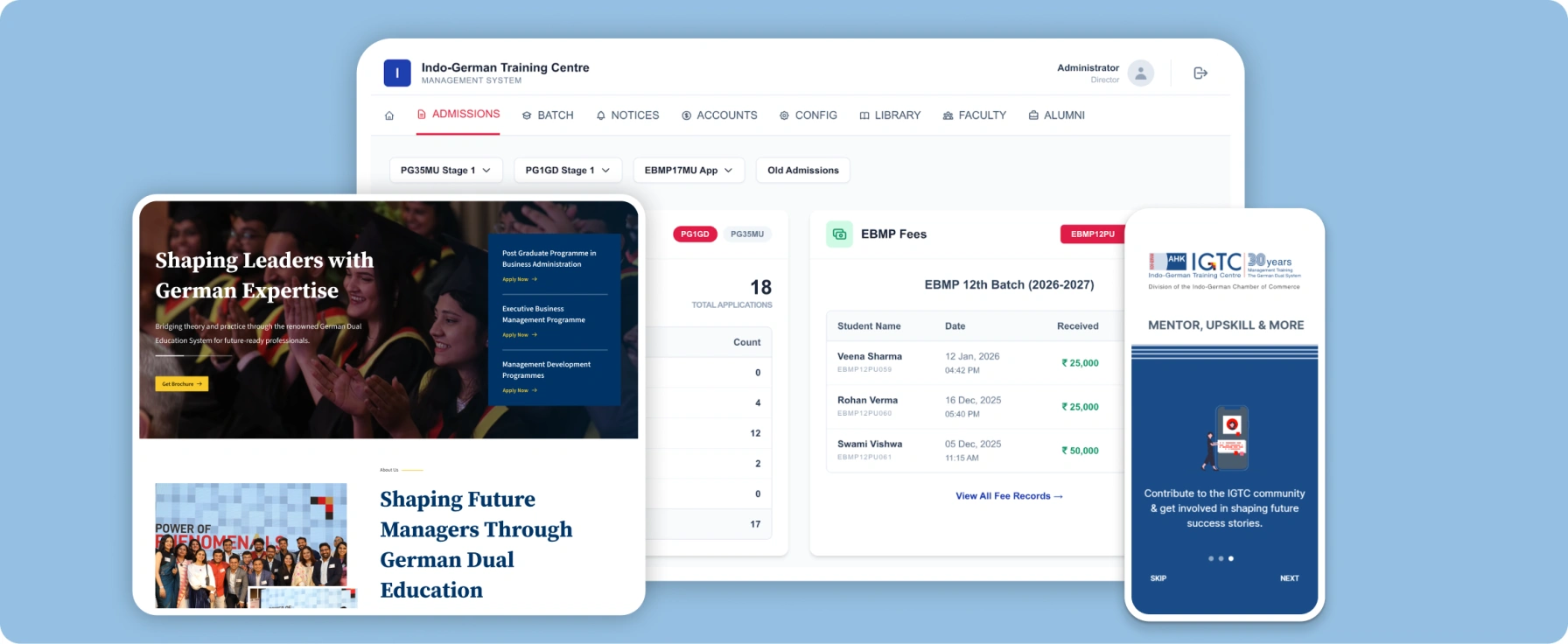
A training institute ran admissions, academics, accounts and corporate coordination on spreadsheets and a platform that did not fit its German dual-education model.
A custom education management system: admissions, student records, fees, batches, attendance and corporate coordination in one place, with reports for the leadership.
20% weekly time saved for staff. The regional director calls the team simply superb and extremely professional.
“They were simply superb and extremely professional.”Radhieka M, Regional Director, Indo-German Chamber of CommerceRead the full case study
Mainstream technologyPHP, Node.js, React, Vue, Flutter: documented and easy to hire for, so nothing ties you to us.
SecurityRole-based access, audit trails, input validation and the OWASP top ten as the checklist.
Data you ownRelational databases with exports and backups in your accounts.
Documented and testedCode in your repository, a deployment pipeline, and training recorded.
Eleven years of designing, developing and automating for other people's businesses taught us three things worth promising.
Tell us what you are planning, or what is holding the business back. A founder who leads the development replies within one working day with questions or a time to talk.
Or WhatsApp +91 99756 22628 and skip the form.
A first release is ₹50,000 onwards at Autuskey, shown in your local currency. Portals, ticketing systems, integrations and apps are quoted against a written scope; user types, integrations, reports and data migration move the price.
Four to eight weeks for a small tool or integration, eight to fourteen for a portal or booking system, ten to sixteen for a mobile app with its backend, and fourteen to twenty for a full business system with several modules.
Off the shelf when your process is standard and a maintained product covers it. Custom when the process is yours, several user types need different views of the same data, or you re-key data between tools. We say which on the first call, and we build on WordPress when that is the honest answer.
When one person holds the process in their head, when the spreadsheet beside the tool has become the real system, or when customers, dealers or students email for things a login should give them. Two of those three mean it is time.
You do. The code lives in a repository in your name from the first week, with the design files, the data and every account. We sign an NDA when you ask, and you can take the system to another developer at any time.
PHP with Laravel or Node.js on the server, React or Vue in the browser, MySQL or PostgreSQL for data, Flutter or React Native for apps, and REST APIs for integrations. All mainstream, documented and easy to hire for; the choice is explained in the scope.
Yes. Most of our clients are businesses with 30 to 200 crore in revenue in India, and small and mid-sized companies overseas. The first release is scoped to what the business needs now, not to a platform it might need later.
Yes. We start with a technology audit of the code, hosting and security, then propose whether to maintain, modernise in stages or rebuild. Ageing PHP applications and spreadsheet-based processes are the usual starting points.
We do, under app care within an annual maintenance contract paid monthly, quarterly or yearly: updates, security, backups, uptime checks and small changes, with a named contact.
Send a brief through the form on this page, or call or WhatsApp +91 99756 22628. Describe the business problem in your own words; we reply by email with questions or a written scope and a fixed price. No obligation.
What we learn designing, developing and automating for clients, written for business owners.